
Future Forms in English: Will, Going to and Present Continuous
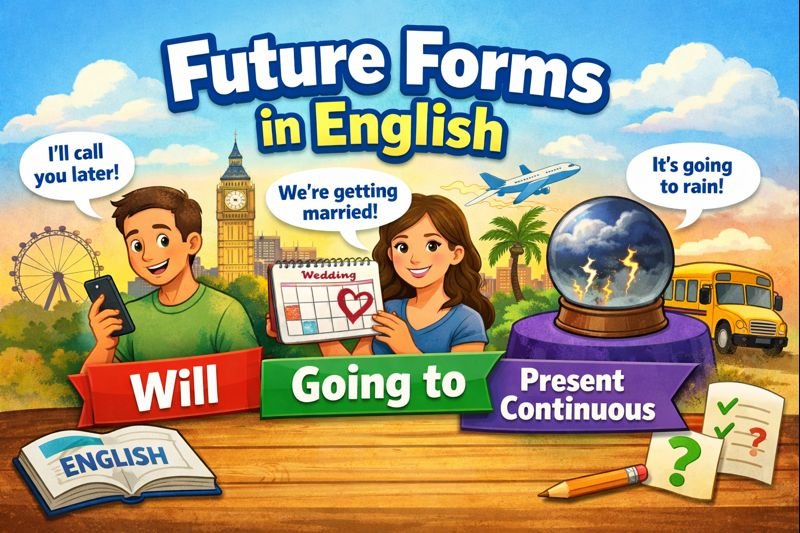
In English, we don’t use only one tense to talk about the future. We use different forms to show plans, decisions, and arrangements.
Sometimes we use will.
Sometimes we use going to.
Sometimes we use the present continuous.
Before you read the grammar rules, try the quiz below. Choose the answer that sounds best to you. Don’t worry about mistakes.
After the quiz, read the grammar section. It explains when and why we use each future form.
This will help you speak about the future more clearly and with more confidence.
Resultados


#1. Look at those dark clouds. It _____ rain.
#2. I promise I _____ call you later.
#3. She already decided. She _____ study medicine.
#4. We bought the tickets yesterday. We _____ to Paris next month.
#5. He thinks his team _____ the match.
#6. I can’t meet you tonight. I _____ dinner with my family.
#7. They _____ married in September. Everything is booked.
#8. What time _____ you _____ your manager tomorrow?
#9. Be careful! You _____ !
What’s Happening in the Cartoon?
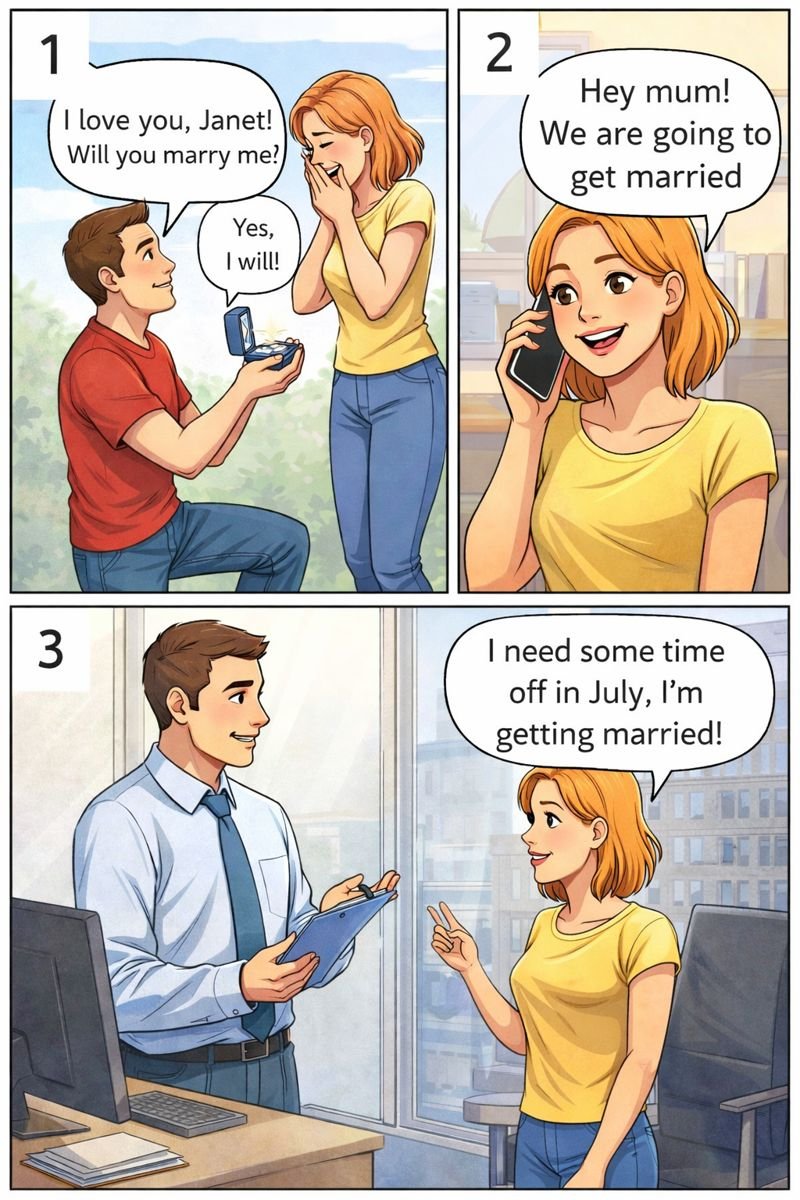
In the cartoon, the same future event is talked about in three different moments, and each moment uses a different future form.
Picture 1
The man says: “Will you marry me?”
Here, will is used because the question is asked at the moment of speaking. It is not about a plan or a schedule. It is a spontaneous decision and an emotional moment.
Picture 2
The woman says: “We are going to get married.”
Now the decision is already made. She is talking about a plan. That’s why we use going to.
Picture 3
She says: “I’m getting married in July.”
This time, the wedding is a fixed arrangement. The date is decided. For this reason, English often uses the present continuous to talk about the future.
Why This Matters
All three sentences talk about the same future event, but English changes the form to show:
a decision at the moment → will
a plan already decided → going to
a fixed arrangement → present continuous
This is why choosing the correct future form is about meaning, not just time.
More Uses of Will and Going to
Will is also used for:
Offers and help
I’ll help you with that.Promises
I’ll call you later.Predictions based on opinion
I think it will be a good film.
Going to is also used for:
Plans and intentions
I’m going to study tonight.Predictions with evidence
Look at those clouds. It’s going to rain.
Present Continuous (Future) is used for:
Fixed arrangements
I’m meeting my boss tomorrow.
Mini Test: Future Forms Check
Choose the correct answer.
1.I’m tired. I _____ go to bed early tonight.
a) will
b) am going to
c) am going
2.Look at that car! It _____ crash!
a) will
b) is going to
c) is crashing
3.“I don’t understand this exercise.”
“Don’t worry, I _____ help you.”
a) am going to
b) am helping
c) will
4.We’ve already decided. We _____ start a new project next month.
a) will
b) are going to
c) are starting
5.What time _____ you _____ your cousin tomorrow?
a) will / meet
b) are going to / meet
c) are / meeting
6.I think English _____ be useful in the future.
a) is going to
b) will
c) is being
Answers:
b) am going to
(plan / intention)b) is going to
(prediction with evidence)c) will
(offer / decision at the moment)b) are going to
(plan already decided)c) are / meeting
(fixed arrangement)b) will
(opinion / prediction)
Thank you Kat!